Deep Sky Images: Horsehead Nebula
The UMD Astronomy Observatory Remains Closed
Spring 2026 Update: The UMD Astronomy Observatory remains closed to all public outreach activities.
Horsehead nebula processing
[The UMD Observatory was able to purchase a new ZWO camera during the Summer 2025. The camera was used for ASTR 310 during Fall 2025 but we didn't really have a chance to "play" with it until later. Elizabeth Warner took a series of images through all of the filters. Student Matthew Prem performed the below analysis.]
Here are the processed photos of the Horsehead Nebula region that you took on December 21, 2025.
Full color image: 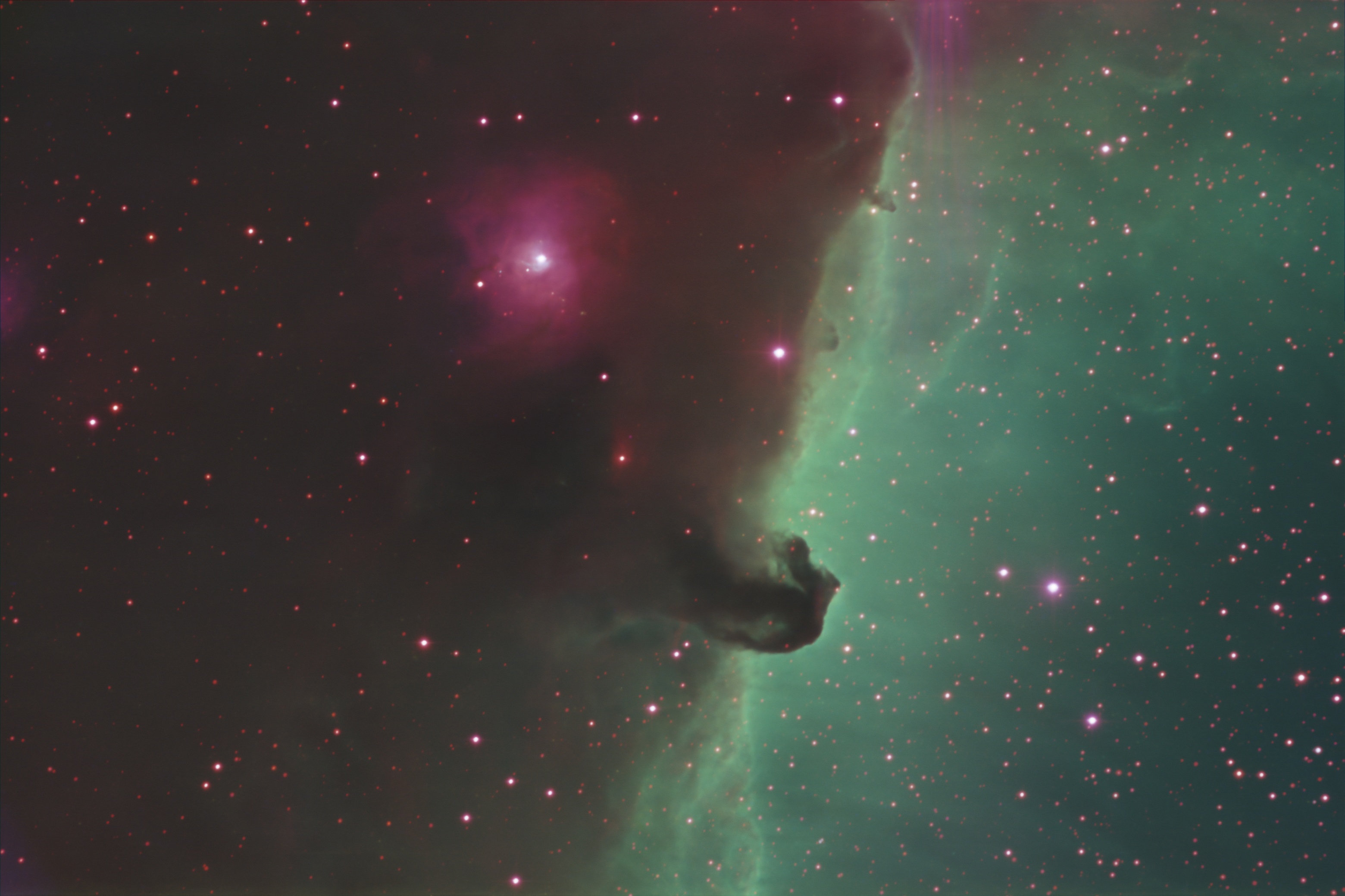 Made with Sloan g' assigned to blue, H-alpha assigned to cyan, [SII] assigned to yellow, and Sloan i' assigned to red. North is up, and East is 4.2 degrees clockwise from left. Each stacked image had GraXpert denoising applied while still linear, then the denoised channels were stretched individually. The individually stretched images were then color-composited, given some final color touch-ups to make the final image look as interesting as possible, and then plate-solved and flipped. There are three image artifacts remaining (at least that I've noticed): a bright spot in the lower-left corner of the image, a brightening all along the bottom of the image, and a row of pixels along the top of the image that is only red. I believe the first two artifacts are leftovers from the slightly sketchy flat calibration, and the red row was just a result of the individual channels being slightly misaligned before color compositing. Normally, I would crop out the red row, but since it is only one pixel across, it was something I overlooked. There are also 2 distant galaxies visible in this image: WISEA J053952.42-022115.3, which has a redshift of ~z=0.105 (which means it's approximately 1.5 billion light-years away), and WISEA J054000.43-022206.8, which has z=0.126 (~1.8 Gly away)! It took a little while to find their names, since they are not in SIMBAD, and I had to go to NED to find out what they were.
Clear: 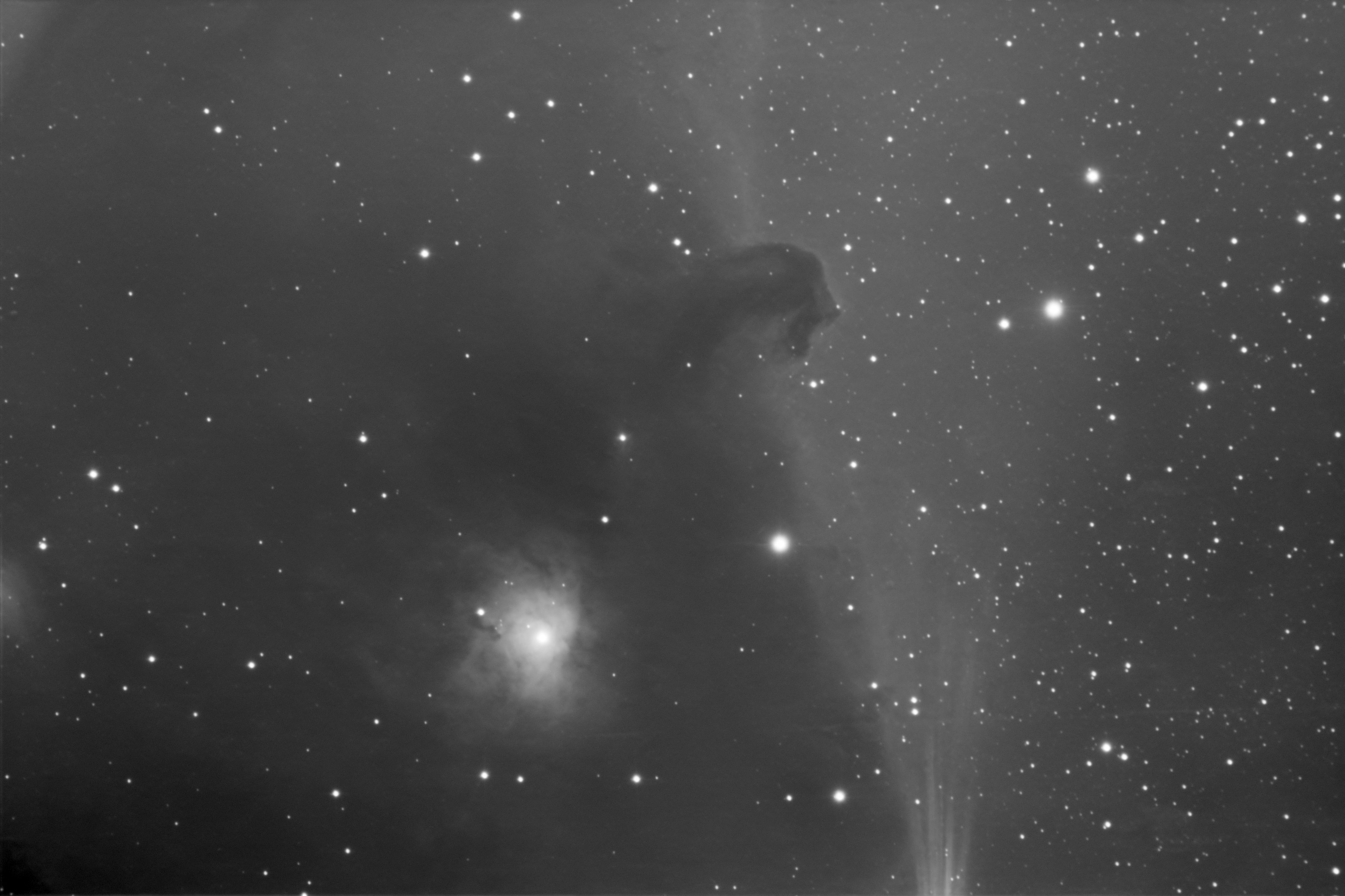 All of the monochrome images are flipped vertically relative to the full color image, as I did not perform plate solving on them, at which point I allow Siril to flip the image so north is generally up and east is generally left. I did not use the clear filter data in the full color image, since it seemed rather washed out, didn't emphasize anything that one or more of the other channels didn't emphasize, and had more noticeable flat artifacts than other images (bright upper-left corner and dark lower-left corner).
Sloan g': 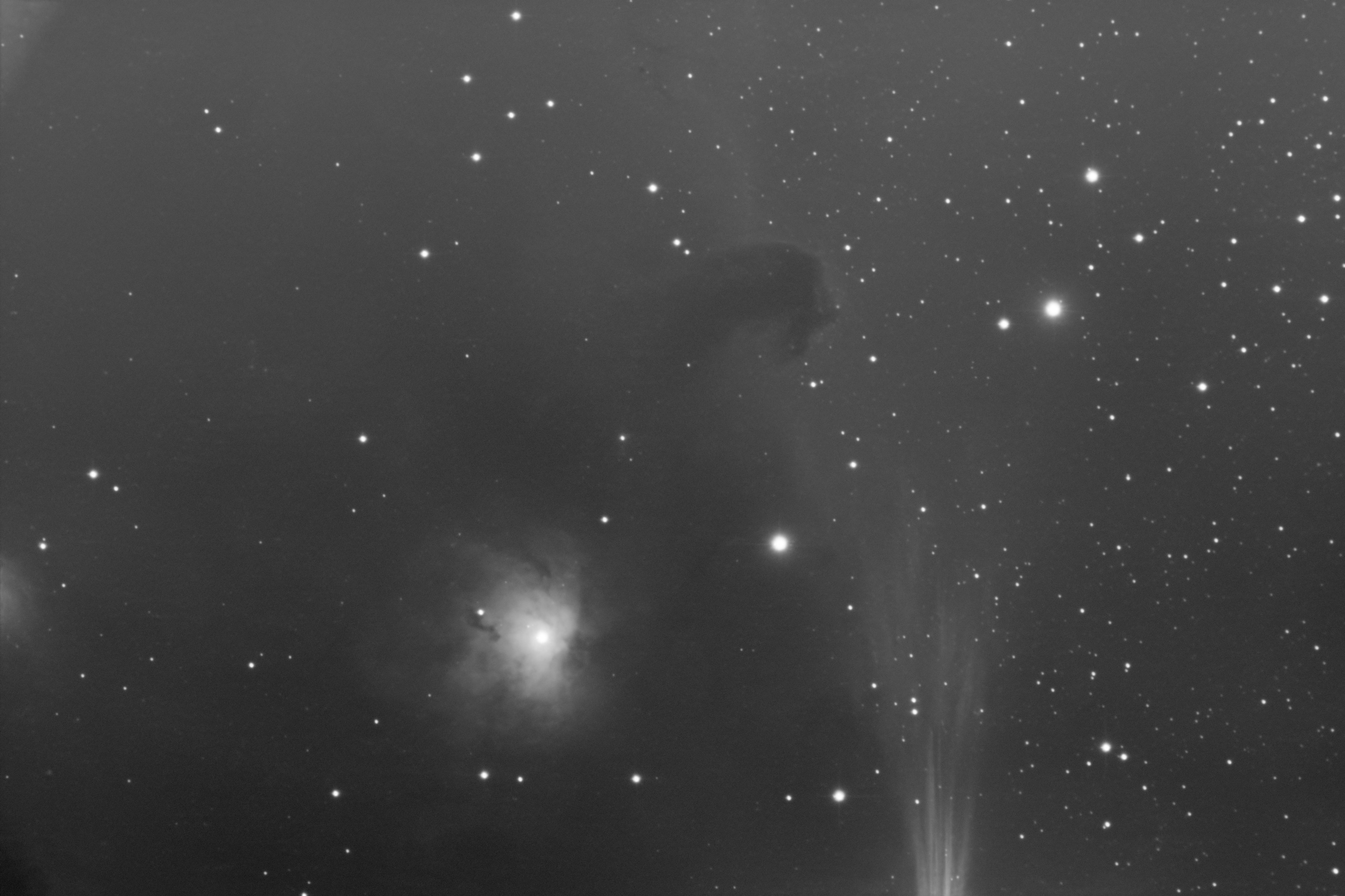 This filter seemed like it had a relatively clean background compared to Clear, though it does seem to have a gradient from top to bottom, which I had to remove, and it also has a bright upper-left corner. The reflection nebulae in the image, NGC 2023 close to the image center, and IC 435 on the left edge of the image, show lots of detail, particularly in the obscuring dust. Its contribution is not super noticeable in the final image, but it does help to add a bit of a color gradient from magenta to red in the reflection nebulae. It's a little interesting that the Horsehead Nebula proper is visible; I assume it is from the Sloan g' filter letting through some Hydrogen-beta light. Also, note that the galaxies are completely invisible in this band.
Sloan r': 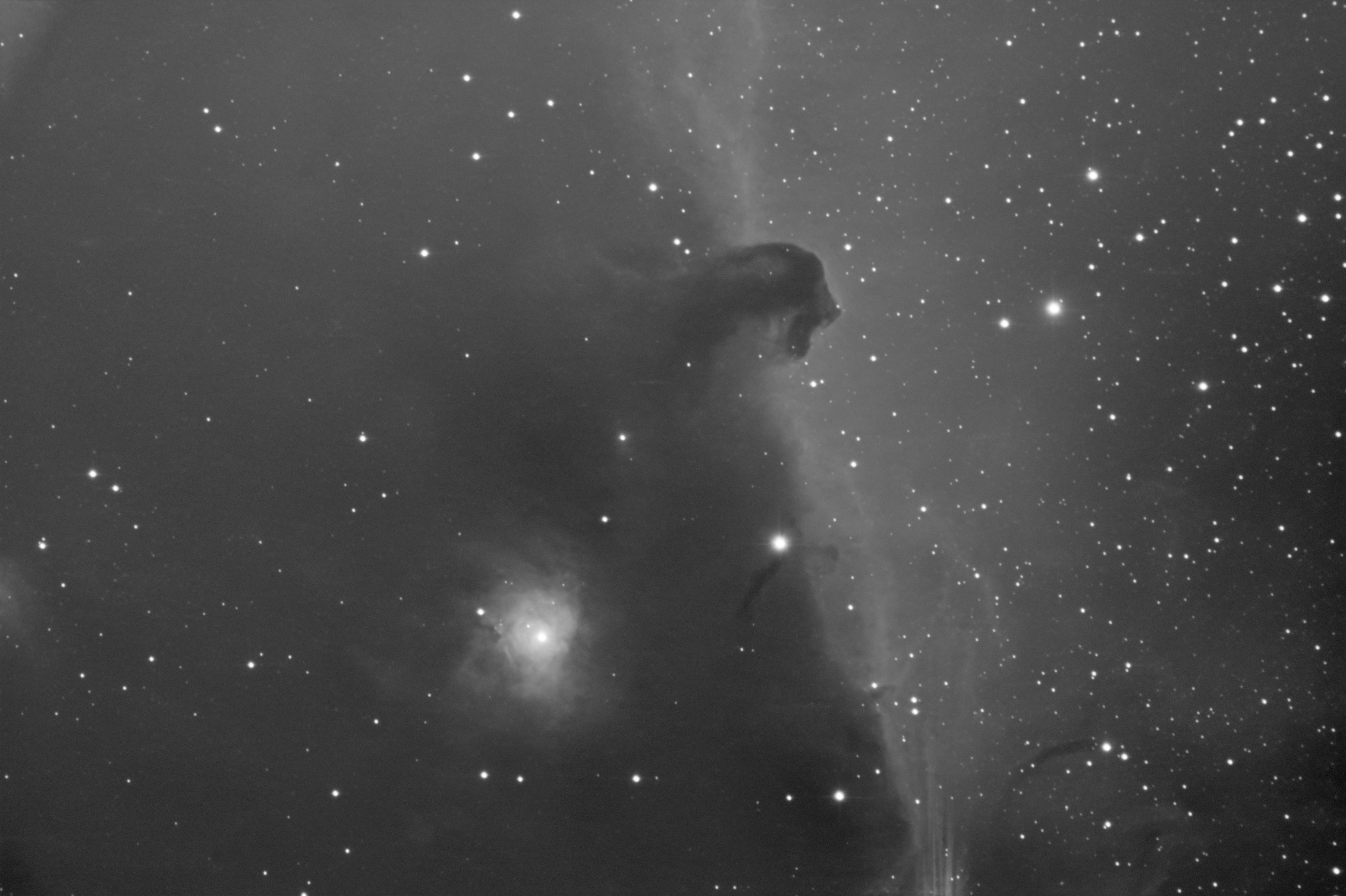 This filter begins to show the galaxies, in addition to many more stars, the Horsehead Nebula, and the reflection nebulae. The main reason I did not use this image in the full-color image is that there were several dust motes I was unable to get to perfectly calibrate out, even after modifying the flat to calibrate out the majority of the dust motes.
Sloan i': 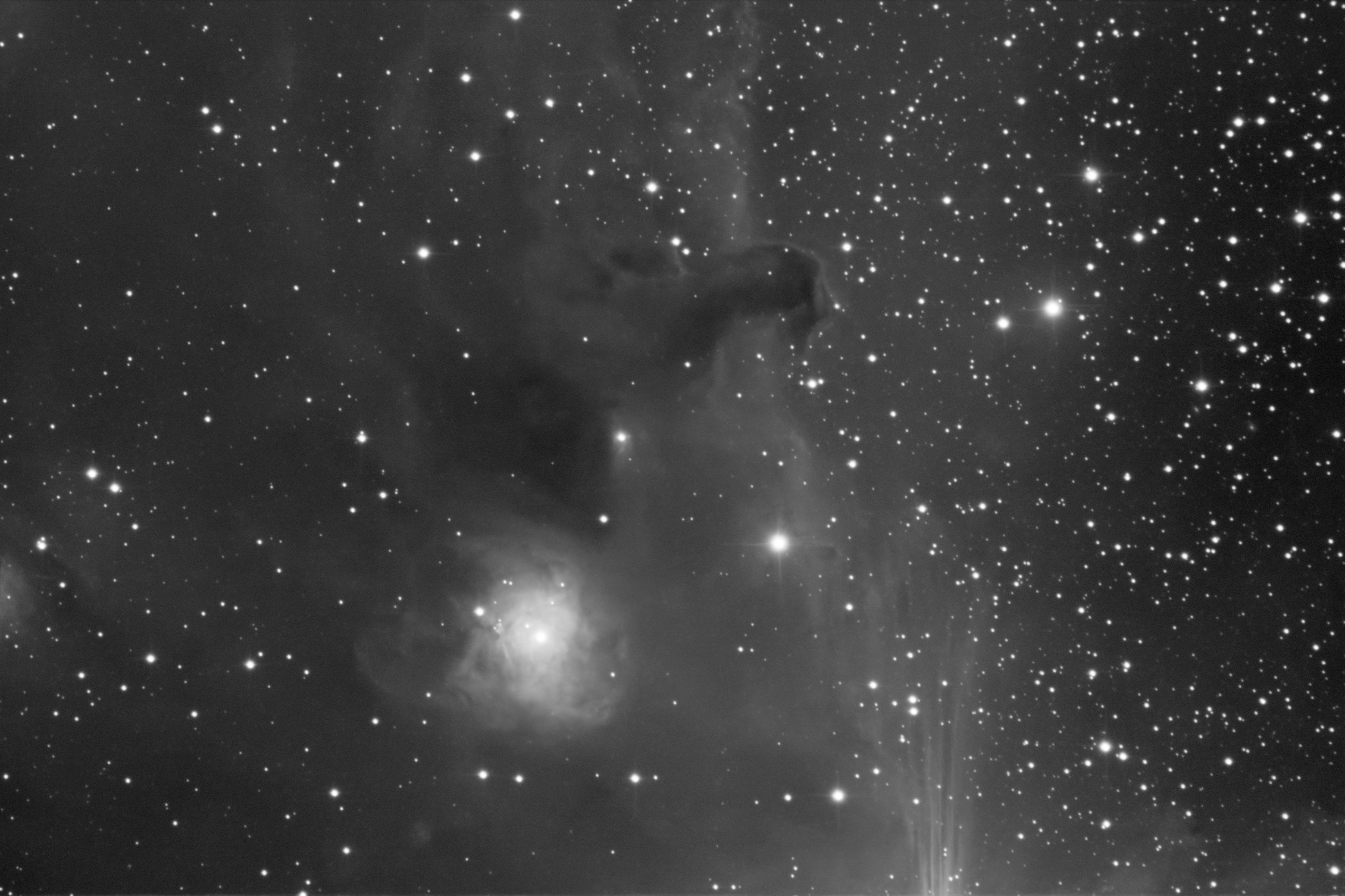 I was quite surprised by how much was visible in this image! The galaxies are pretty easily visible on the right of the image, the reflection nebulae are very extended, and an incredible amount of detail is seen in the dust clouds themselves. Honestly, I think this might be my favorite filter for this target, which is surprising considering how the sensitivity of this camera is supposed to fall off at longer wavelengths. I wonder if there is a way to check the manufacturer's sensitivity chart.
[O III]: ![monochrome (grey scale) image of Horsehead Neb using the [O III] filter](horsehead/oiii.jpg) Not a whole lot to see here. Bits of the reflection nebulae come through, and because NGC2023 does ionize some gas, it's rather visible. Beyond that, really all you can see are a handful of stars, so this image was not included in the color image. Looking at the raw stacked image before denoising highlights just how little is visible.
Not a whole lot to see here. Bits of the reflection nebulae come through, and because NGC2023 does ionize some gas, it's rather visible. Beyond that, really all you can see are a handful of stars, so this image was not included in the color image. Looking at the raw stacked image before denoising highlights just how little is visible.
H-alpha: 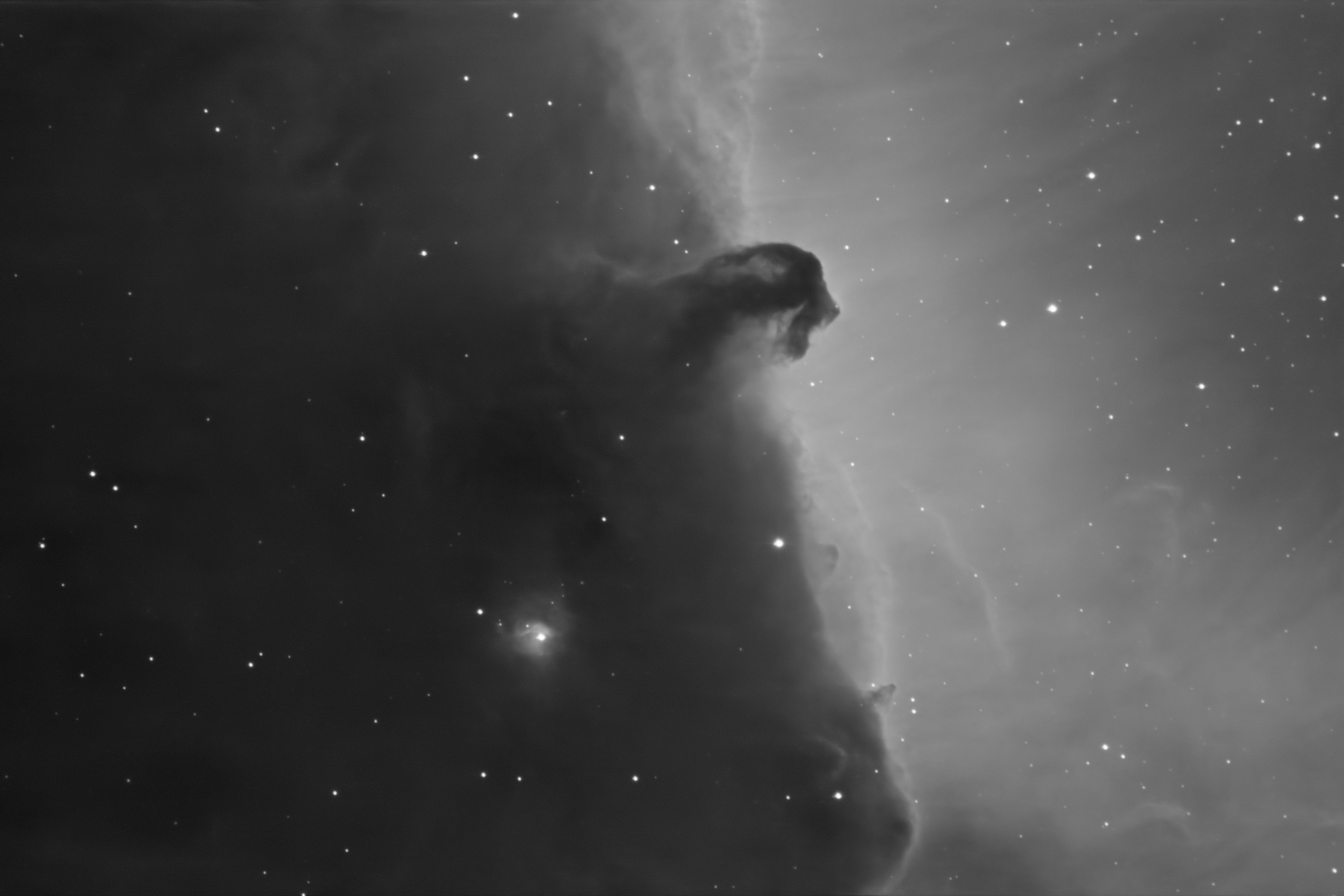 Lots of good detail here. I love the striations in IC 434; apparently, these are caused by magnetic fields in the region.
[S II]: ![monochrome (grey scale) image of Horsehead Neb using the [S II] filter](horsehead/sii.jpg) Overall, looks pretty similar to H-alpha, though NGC2023 is larger, and the smaller-scale structure stands out more. I think we are mostly limited by the total exposure time in this filter, as the denoising process added a few "mottling" artifacts.
Overall, looks pretty similar to H-alpha, though NGC2023 is larger, and the smaller-scale structure stands out more. I think we are mostly limited by the total exposure time in this filter, as the denoising process added a few "mottling" artifacts.
Flats: After going through the normal calibration process, the cratering around the dust spots was very apparent. Operating under the assumption that the cratering is a result of a linear shift between observing and flat frame collection, I decided to try shifting the flat frames before using them in the calibration process. After figuring out a way to coax Siril into shifting the flat frames (it's not exactly designed for this), I found that a 9 pixel vertical shift completely removed the dust artifacts (except for a small number of dust artifacts in the Sloan r' image). I then used these shifted flats to process the data. The two main downsides to using these shifted flats are:
- There are now 9 rows of pixels at the bottom of each image, where we have no flat information, which means we are throwing away data.
- The per-pixel sensitivity correction is now being applied to the wrong pixels. This shows up in the final, stacked image as noise that seems a little off, at least compared with the Gaussian noise we are used to seeing in stacked images. With very long integration times, this will become more and more of a problem, as this is a fixed-pattern noise that does not go away with simple averaging. Dithering would help, but that would require a large number of frames to work effectively, and ideally, we would find a way to not have this problem at all. This noise pattern is particularly noticeable in the clear filter image, so I've attached a screenshot of that noise pattern here:
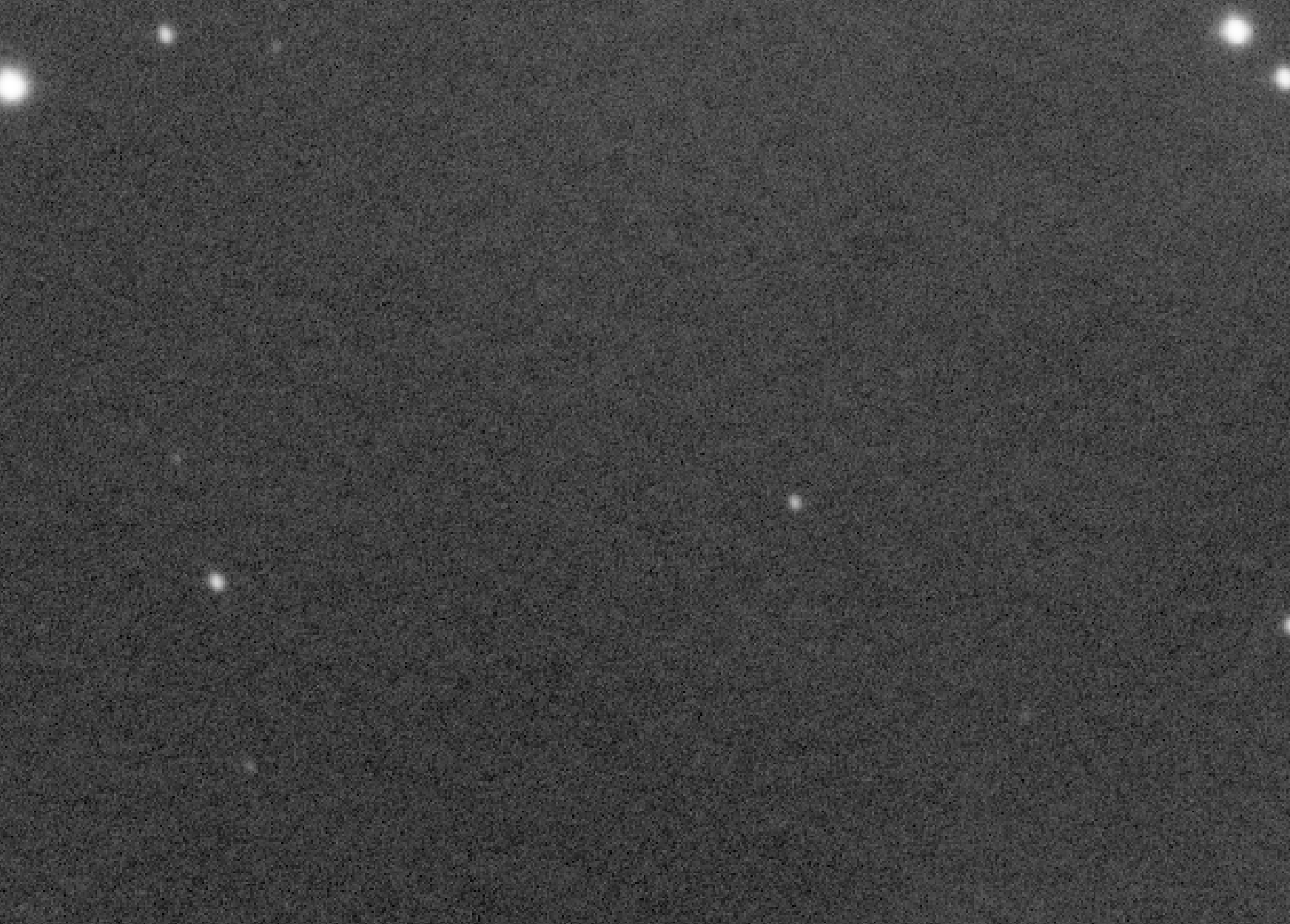
Our tests with sky flats early in the semester suggest that when sky flats are taken, flat shifting is not required to prevent cratering, so if that reasoning holds, sky flats would be ideal. However, if you want to trade more time spent processing later in exchange for capturing data at a more convenient time, that at least seems to be an option in certain use cases. For this particular use case, the strange noise pattern turned out not to be an issue, as the GraXpert denoising was able to remove it, but we don't really want to rely on that.
For these images, I also corrected the cratering by shifting the entire image by 9 pixels. However, since the per-pixel noise patterns are at a different scale than the dust spots, a multiscale approach might produce better results. I've spent a bit of time thinking about a possible solution, and I have an idea of a good first thing to try, but I don't think I will, as there are better uses of my time.
Star streaking: If you look closely at the stars in some of the images, you can see minor east-west streaking, likely due to the guiding compensating for the lack of tracking. It's not very noticeable, but it is there.
Clear skies!
-Matthew