ASTR 288T Spring 2026
The UMD Astronomy Observatory Remains Closed
Spring 2026 Update: The UMD Astronomy Observatory remains closed to all public outreach activities.
ASTR 288T Introduction to Astrophotography is the Astronomy Department's first Student Initiated Course (STICs) and was first offered in Spring 2025, taught by senior Chaitanya Garg and sophomore Matthew Prem. The second cohort in Spring 2026 was taught by junior Matthew Prem and sophomore Paul Voelker. Below are the results of the team projects:
Messier 101: A Pinwheel of Star Formation
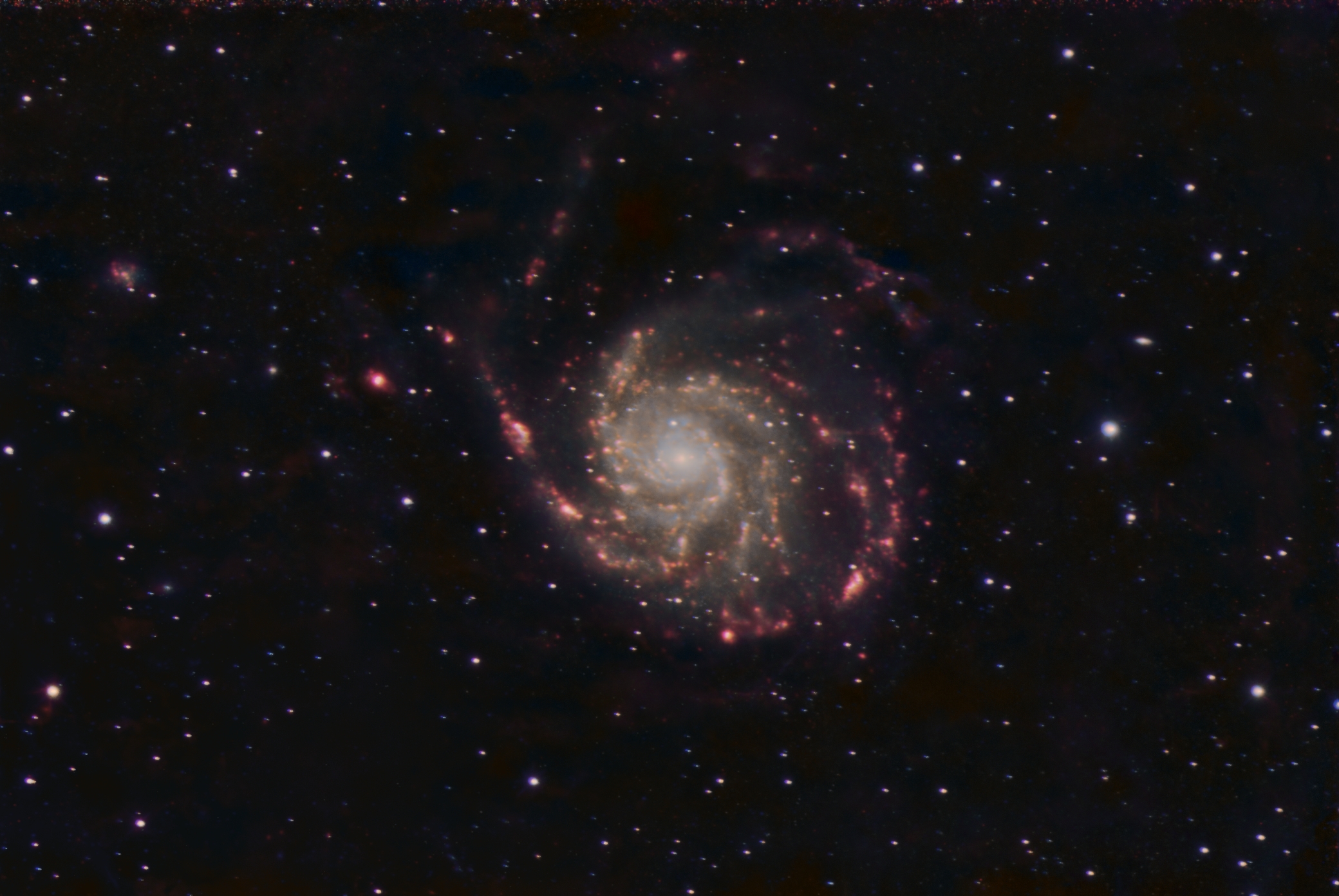
Telescope: 178mm (aka 7") f/9 Astro-Physics refractor
Camera: ZWO ASI2600MM-P cooled monochrome CMOS
FOV: 49.1' x 32.9'
Data:
15x180s = 0.75h Hα --> Red
15x180s = 0.75h Sloan r'--> Green
15x180s = 0.75h Sloan g'--> Blue
Total exposure = 2.25 hours
Software: Siril (calibration, registration, stacking, color compositing, and stretching), GraXpert (AI denoising))
Image credit: Stina Drill, Safiya Gross, Robert Martinazzi, and Zory Teselko
Description: What's the largest pinwheel you've ever seen? Even if you count the largest wind turbines, which can have diameters of over 310 meters, this spiral galaxy has them beat, with light taking around 200,000 years to get from one side to the other! Previous interactions with nearby galaxies (such as the dwarf galaxy NGC 5477 in the upper left) have left Messier 101 with distinct spiral arms that glow brightly with the deep red emission of Hydrogen-alpha. Stars in the dense center of the galaxy were captured using Sloan broadband filters and show up as a diffuse orange glow punctuated by dust lanes, far beyond stars belonging to our own Milky Way Galaxy dotting the image. In order to combat the low signal recorded, particularly through the Hydrogen narrowband filter, this image has been run through an AI denoising program trained specifically for astrophotography, which, while being very effective at removing noise, can result in an overly smooth image or hallucinated stars. After carefully weighing the pros and cons of this tool, this team decided that it was worth using to more closely match their artistic vision and the intended impact of the image.
Messier 82: A Galactic Sneeze
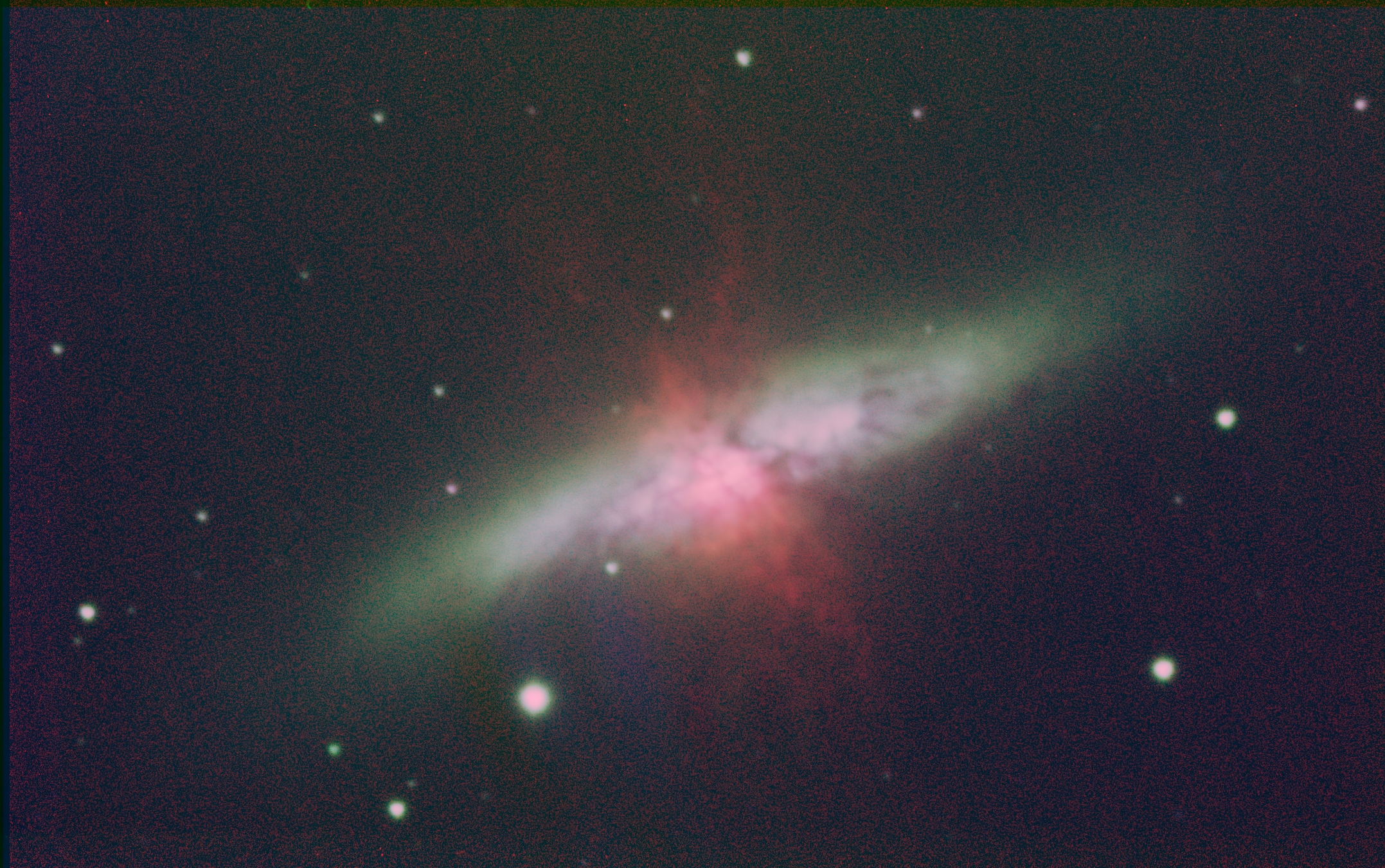
Telescope: 14" f/11 SCT (Celestron C14)
Camera: ST-10XME cooled monochrome CCD
FOV: 11.1' x 7'
Data:
39x180s = 1.95h Hα --> Red
38x180s = 1.9h Sloan r'--> Blue
38x180s = 1.9h Sloan g'--> Green
Total exposure = 5.75 hours
Software: Siril (calibration, registration, stacking, color compositing, and stretching), GraXpert (AI denoising)
Image credit: Zoe Brunton, Ian Cutler, Georgia Garner, and Hannah Sitther
Description: Is this galaxy sneezing? Perhaps, in the sense that it's rapidly ejecting gas from its core, but rather than being caused by pollen or a cold, like human sneezes often are, this galactic outflow is caused by a recent interaction with the nearby spiral galaxy Messier 81. The resulting gravitational disturbance has caused a burst of star formation in Messier 82, leading to large quantities of ionized hydrogen being ejected from the galaxy, the light of which, displayed in this image as red, can be captured here on Earth using a Hydrogen-alpha narrowband filter. The young, hot, and blue stars driving this wind give the galaxy a green hue in this image due to the artistic palette choice. Showing careful consideration of the usage of AI image denoising, this team decided to use GraXpert AI denoising on the data collected through the broadband filters, where the higher Signal to Noise Ratio (SNR) makes hallucinated stars less likely, while not running the Hydrogen-alpha data through the system.
NGC 2244: A Rosette of Gas
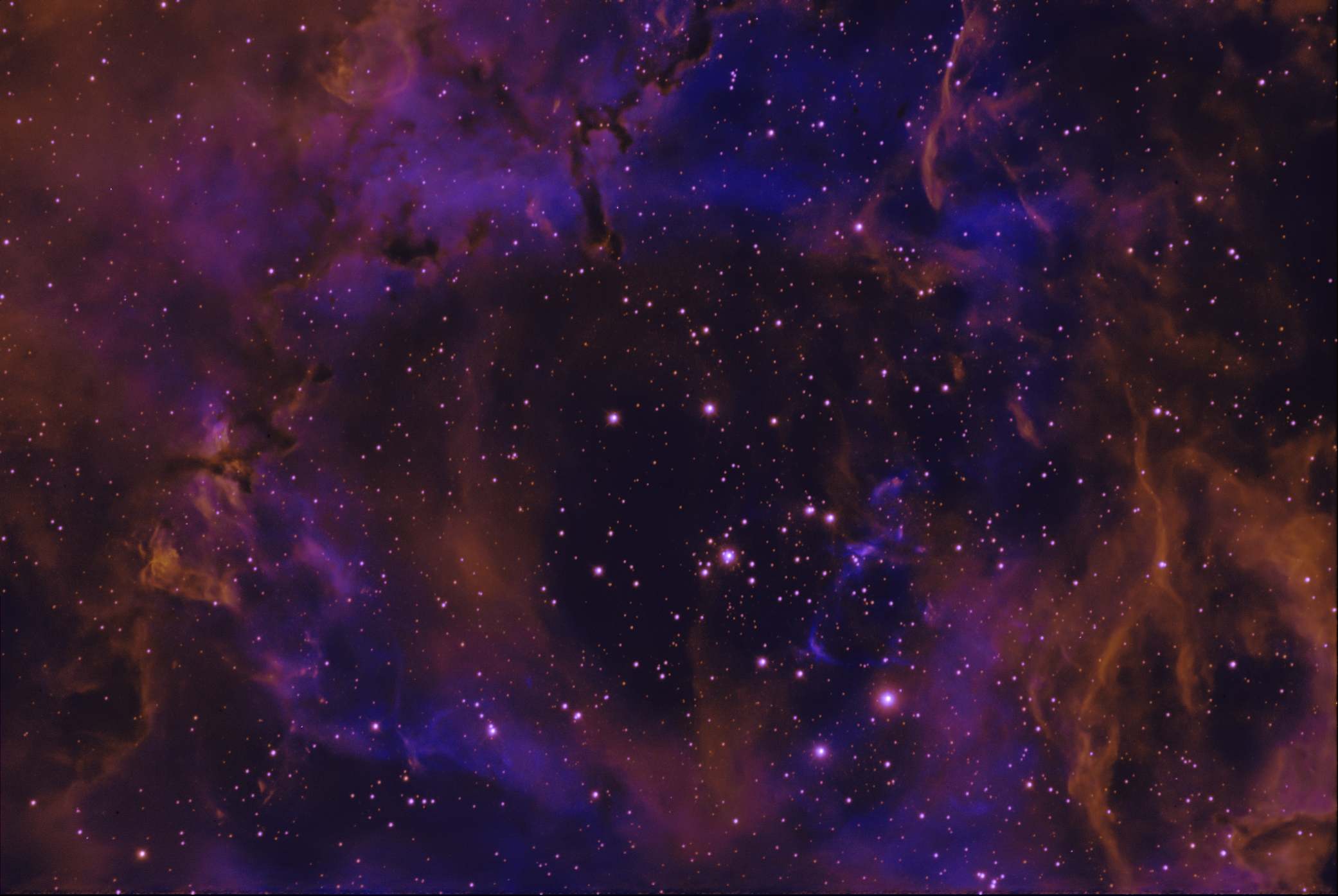
Telescope: 178mm (aka 7") f/9 Astro-Physics refractor
Camera: ZWO ASI2600MM-P cooled monochrome CMOS
FOV: 49.2' x 32.9'
Data:
11x180s = 0.55h [OIII] --> Blue
11x180s = 0.55h [SII] --> Orange
Total exposure = 1.1 hours
Software: Siril (calibration, registration, stacking, color compositing, and stretching), GraXpert (AI denoising)
Image credit: Akhil Mallajosyula, Leeaan Shaw, and Olivia Yuen
Description: What do you see when you look into this nebula? A cosmic whirlpool of gas flowing in? The petals of a blooming flower? Or perhaps you imagine you are looking into the iris of some form of giant skull? As flowery as many of these descriptions may be (especially this nebula's common name of the Rosette Nebula), what we're actually seeing is an expanding bubble of hot gas, ionized by the intense light of the young stars within NGC 2244. The different colors shown here indicate where singly-ionized sulfur is glowing (orange) and doubly-ionized oxygen (blue). At some point in the distant future, this nebula will dissipate as the radiation and solar winds from these hot, young stars ionize and blow away the gas we currently see them encased in. Due to the low surface brightness of this nebula, this group decided to use the AI denoising program GraXpert to bring out additional details in their narrowband images.
NGC 2264: A Celestial Christmas Tree
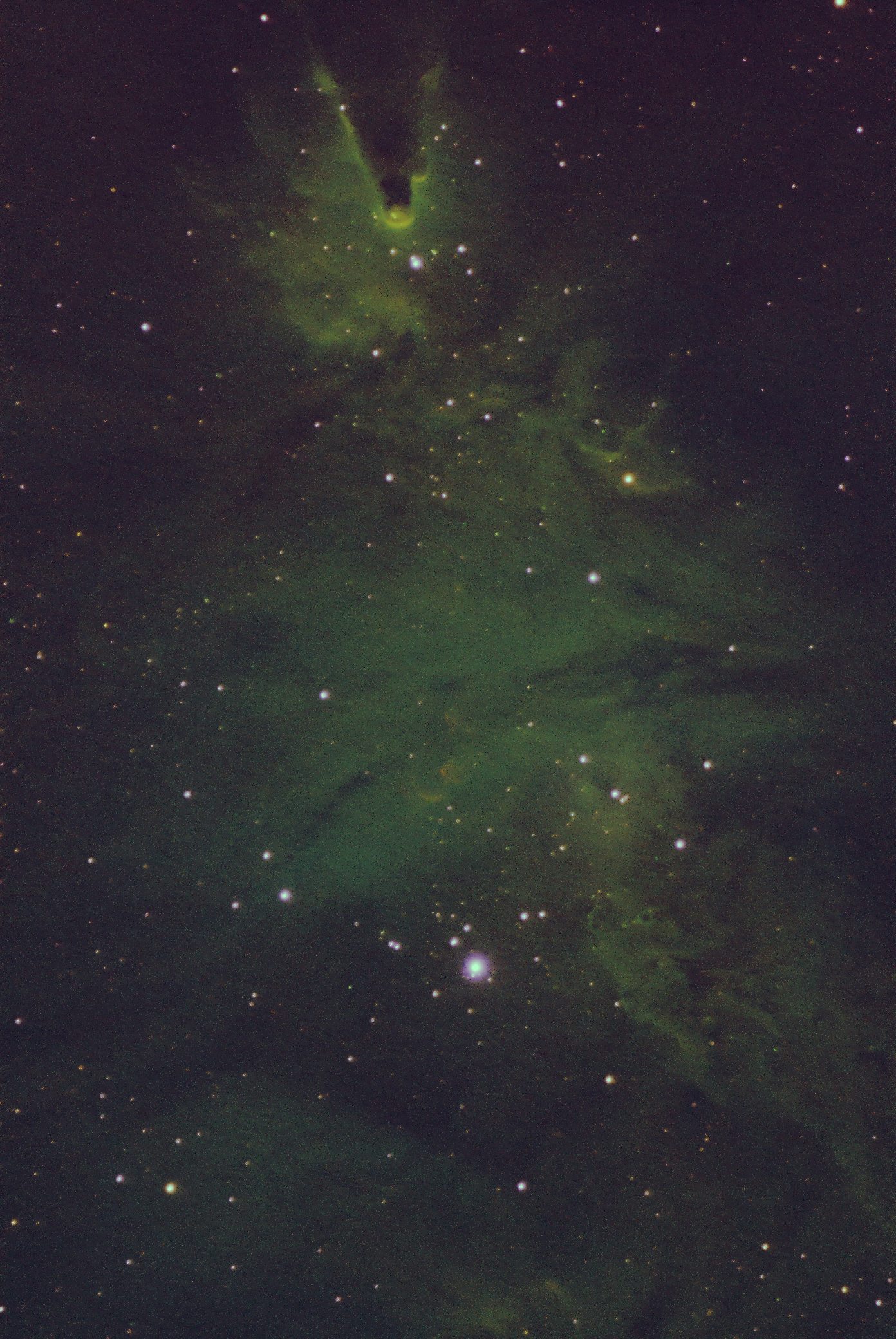
Telescope: 178mm (aka 7") f/9 Astro-Physics refractor
Camera: ZWO ASI2600MM-P cooled monochrome CMOS
FOV: 32.9' x 49.1'
Data:
17x180s = 0.85h [SII] --> Red
17x180s = 0.85h Hα --> Green
17x180s = 0.85h [OIII] --> Blue
Total exposure = 2.55 hours
Software: Siril (calibration, registration, stacking, color compositing, and stretching)
Image credit: Clara Allen, Megan Arnold, Aimee Boardway Tukey, and Daisy Navarro
Description: What's in this festively-colored image? If you see a green Christmas tree, you'd technically be incorrect; the largest known conifer is only 116 meters tall, while this image spans around 20 light-years. However, you'd be in good company, with the triangular appearance of the star cluster NGC 2264 bearing a strong resemblance to Christmas ornaments, while the striking Cone Nebula acts as a tree-topper! The green in this false-color image is created by hydrogen gas, energized by the hot, young stars of NGC 2264. While the light produced by this nebula would appear as a deep red to the human eye, this team has shifted the colors to allow the light from Sulfer to be red and give this image its wonderful, festive appearance!
Messier 51: A Whirlpool of Merging Galaxies
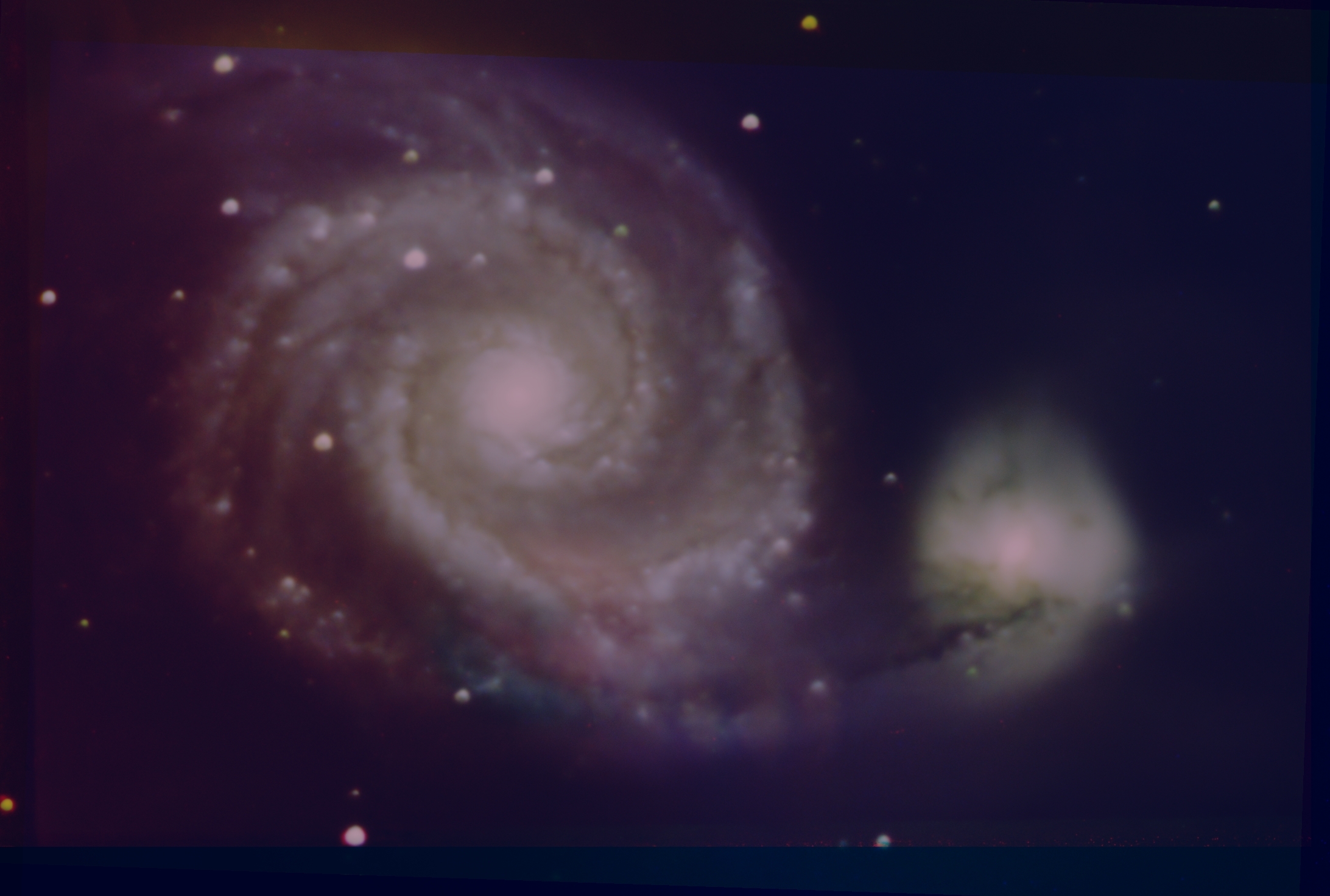
Telescope: 14" f/11 SCT (Celestron C14)
Camera: ST-10XME cooled monochrome CCD
FOV: 11.3' x 7.6'
Data:
17x180s = 0.85h [S II] --> Red
17x180s = 0.85h Hα --> Green
17x180s = 0.85h [O III] --> Blue
Total exposure = 2.55 hours
Software: Siril (calibration, registration, stacking, color compositing, and stretching), GraXpert (AI denoising)
Image credit: Payton Manoogian, Amanda Lau, Leila Sherard, Advik Duvvuri
Description: What happens when two galaxies collide? Sometimes, when the conditions are right, the gravitational interaction will cause gas clouds to collapse, leading to an increase in star formation and brighter, more distinct, spiral arms. Messier 51, known as the Whirlpool galaxy, is one such galaxy where this has occurred, while its companion, an older, redder galaxy, is nearly devoid of star formation. Captured here using broadband filters to highlight the light emitted by stars in the colliding galaxies, this image excellently showcases the differing colors and levels of dust in each of the colliding galaxies. In order to help bring out faint details, this team decided to run their images through the AI denoising program GraXpert. While this program can result in hallucinated stars, the real stars in this photo appear much wider and have a different Point Spread Function (PSF) than the hallucinated stars, making it easy to tell what's real and what's fake apart.
Students also had the option to share their individual final projects:
Messier 94: A Cosmic Eye
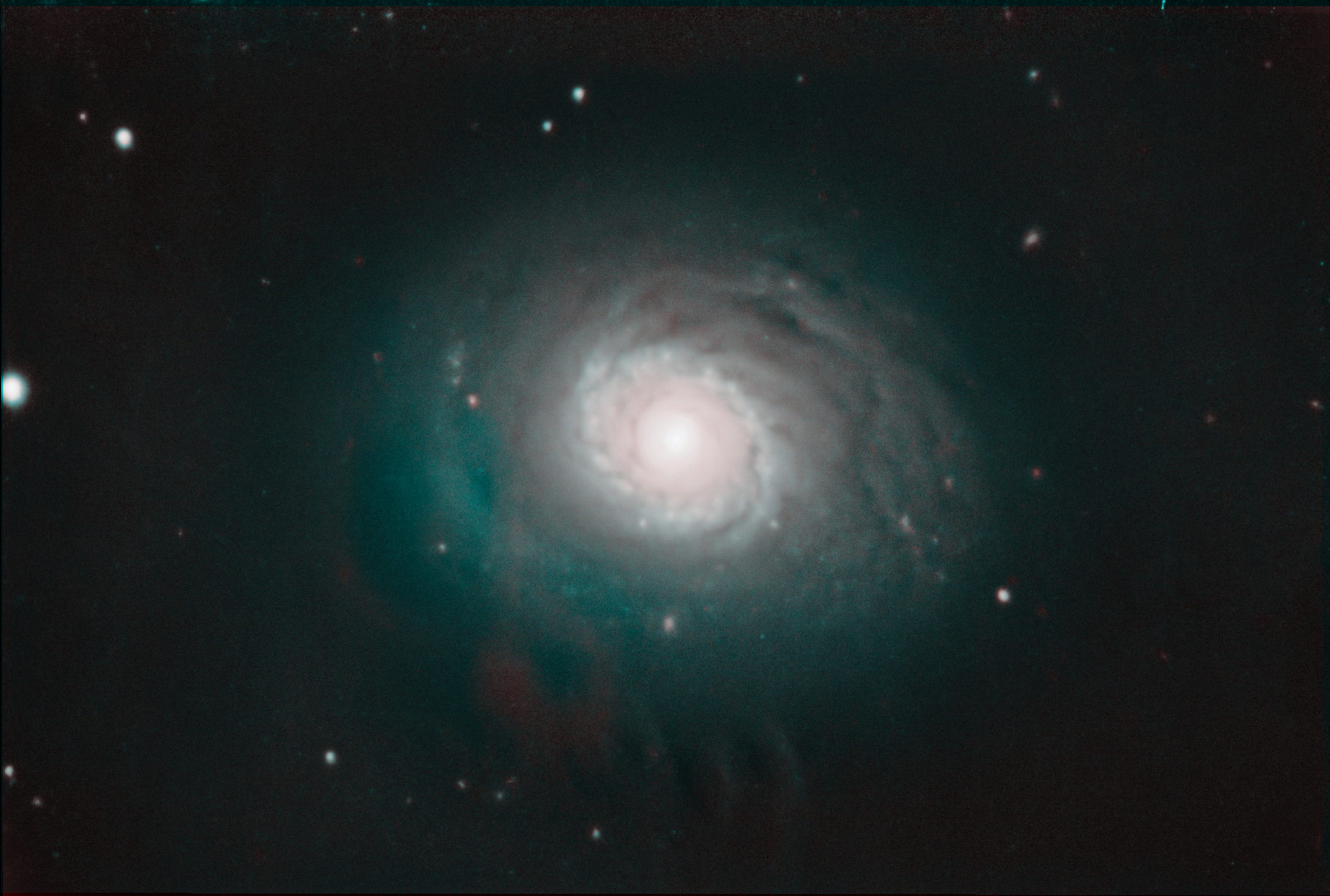
Telescope: 14" f/11 SCT (Celestron C14)
Camera: ST-10XME cooled monochrome CCD
FOV: 11.3' x 7.6'
Data:
25x180s = 1.25h Sloan r' --> Red
24x180s = 1.2h Sloan g' --> Cyan
Total exposure: 2.45 hours
Software: Siril (calibration, registration, stacking, color compositing, and stretching), GraXpert (AI denoising)
Image credit: Zoe Brunton